Precision for steering: the role of the tie rod in the truck
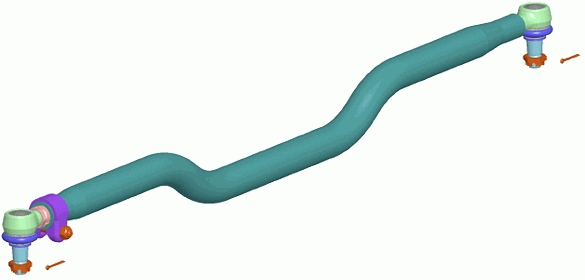
The tie rod is the crucial connecting element between the steering gear and the steering knuckles of the wheels. In commercial vehicles, it has to transmit enormous steering forces and at the same time guarantee that the vehicle tracks precisely under heavy loads. A precisely adjusted tie rod not only ensures a direct steering feel, but also minimizes rolling resistance. This leads to even tire wear and noticeable fuel savings. Our components are designed to meet the high mechanical demands of long-distance driving and ensure the exact geometry of your chassis.
Safety thanks to first-class tie rod ends and joints
Wear on the steering often announces itself gradually. A worn tie rod end or a defective axial joint impair directional stability and can become a safety risk under extreme loads. As these components are permanently exposed to dirt, water and vibrations, the quality of the dust protection sleeves and the inner ball sockets is crucial. At FZB Fahrzeugbedarf, you will find spare parts in OEM quality that guarantee a long service life thanks to high-quality alloys and excellent lubrication and prevent expensive consequential damage to the tires or steering gear.

What should you look out for when buying:
Extreme loads and the highest safety requirements in trucks
The steering and chassis components of a truck are exposed to exponentially higher forces compared to a passenger car. Tie rods and joints in trucks have to absorb the enormous axial and radial loads of the heavy axles, the large tires and the high payload. This requires superior material quality and uncompromising manufacturing quality. Given the fact that failure of these components while driving poses a catastrophic safety threat, fatigue resistance and adherence to the tightest tolerances are absolutely crucial. The components must not only transmit steering movements, but also withstand shock loads, braking forces and the constant vibration of driving without damage.
Precision for track and steering geometry
To ensure optimum directional stability and low tire wear – both decisive economic factors in the vehicle fleet – track rods and their joints must enable precise adjustment of the steering trapezoid geometry. The components must be precisely adjustable in order to set the correct toe-in or toe-out. When replacing truck track rods, not only the fit (length, cone) but also the rigidity of the replacement part must correspond to the original specification. This is the only way to ensure that the steering returns to the neutral position quickly and without “wandering” under load and that the directional stability of the loaded vehicle is guaranteed at all times.
Joint protection and maintenance-free for long intervals
Another critical point in truck operation is the protection of the ball and tie rod joints. Given the long maintenance intervals of commercial vehicles and the constant exposure to dirt, water, road salt and aggressive chemicals, the dust boot of the joint is a key wear part. A defective or inferior boot very quickly leads to the ingress of dirt, which destroys the ball pin and the bearing shells within a short time and leads to dangerous play in the steering. High-quality tie rod joints for trucks are therefore often designed as maintenance-free units with a perfectly sealed, robust construction and optimized lifetime lubrication.
Steering technology guide: Frequently asked questions about tie rods & joints