
Electric Trucks in the Fleet: Is It Already Worth Making the Switch in 2026?
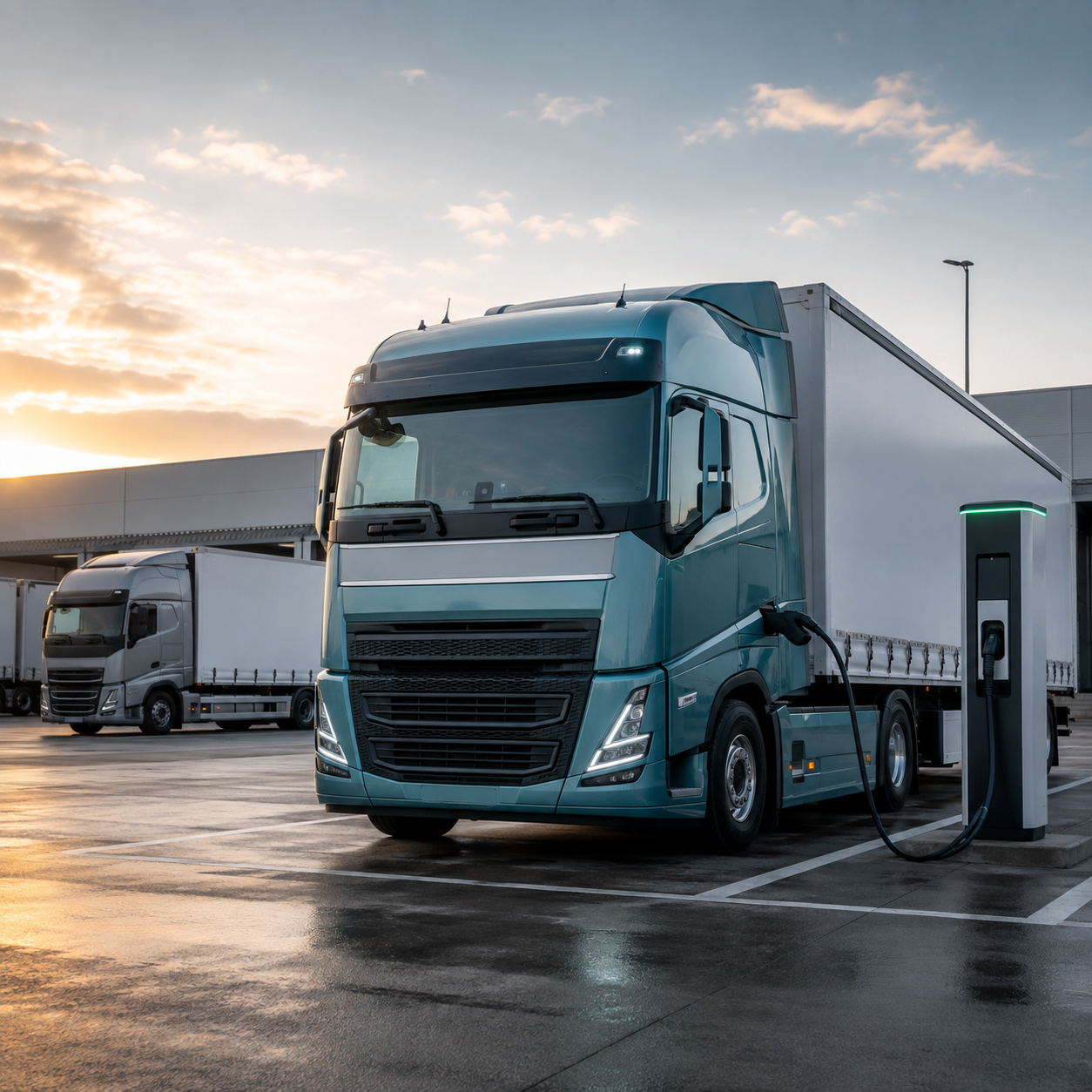
Hardly any other topic is discussed as heatedly in the trucking industry as electric trucks. Some see them as the future; others view them as an expensive experiment with too little range. As is so often the case, the honest answer lies somewhere in between—and it depends above all on what you drive, where you drive, and how often. This article breaks down what has changed by 2026, where electric trucks are already proving their worth today, and where diesel still has the edge.
What Has Changed in 2026
Two developments are making the outlook for 2026 much more favorable for zero-emission vehicles.
First, the toll: Zero-emission trucks weighing more than 3.5 metric tons receive a 75 percent discount on the infrastructure portion of the toll—and this discount has been extended through 2030. This provides the planning certainty that is crucial for investments spanning several years. At the same time, the toll for diesel vehicles is moving in the opposite direction: Starting in 2024, it will also depend on CO₂ emission classes, and the thresholds were tightened in mid-2026. As a result, vehicles that previously fell into a lower-cost class tend to slip into a more expensive one. The gap between diesel and electric vehicles in terms of toll costs is thus continuing to widen.
Second, the subsidies: Through the “eMove Austria” program—specifically the ENIN (Emissions-Free Commercial Vehicles and Infrastructure) track—up to 60 percent of the additional costs for Class N2 and N3 vehicles compared to a comparable diesel vehicle are covered, along with 40 percent of the investment costs for charging or refueling infrastructure. This is administered by the FFG funding agency through ongoing calls for proposals. In addition, the tax investment allowance for electric vehicles has been raised to 22 percent of the purchase price—temporarily, until the end of 2026.
Bottom line: The price gap compared to diesel—which for years has been the main argument against making the switch—will be smaller than ever in 2026—provided you take advantage of the incentive.
Where Electric Trucks Are Already Making Their Mark Today
Electric trucks really shine in situations where their use can be planned in advance:
- Regional and predictable routes: Distribution, delivery, factory transport, municipal operations—anywhere the vehicle returns to its home base in the evening, the operational profile aligns with today’s driving range.
- Charging at the depot: Those who charge overnight at the depot using their own electricity—ideally from a solar PV system—can significantly reduce energy costs below diesel levels—and remain independent of the still-sparse public charging infrastructure.
- High mileage: The more kilometers a vehicle travels, the faster the higher purchase costs pay for themselves through lower energy and toll costs.
- Fewer wear parts in the drivetrain: No oil changes, no exhaust system, fewer moving parts. The brakes last longer thanks to regenerative braking. This reduces maintenance costs in the powertrain.
For a business with fixed regional routes and a charging station on the farm, the overall costs can already be covered today.
Where Diesel (Still) Has the Edge
It’s just as important to be honest about the other side of the story:
- Long-distance transport and long routes: When covering high daily mileage with limited downtime, range and charging time remain the key challenges. Although the public fast-charging infrastructure for heavy-duty trucks is being expanded, it does not yet provide nationwide coverage.
- Heavy loads and topography: Maximum payload over long inclines reduces range. In addition, the weight of the battery can reduce the payload, even though there are legal compensation regulations in place to address this.
- Purchase despite subsidies: Even with a 60 percent subsidy on the additional costs, the initial investment remains higher than for diesel. Not every company can or wants to tie up this capital.
- Uncertainty Regarding Resale Value: The used market for electric trucks is still in its infancy. It is currently more difficult to predict how residual values will develop than it is for established diesel trucks.
Those engaged in heavy-duty long-haul trucking will, in many cases, still be relying on diesel in 2026—and that is not a mistake, but a practical decision.
The figure that matters: total cost instead of purchase price
The most common mistake people make when it comes to this topic is focusing solely on the purchase price. What really matters is the total cost over the holding period. The calculation should include:
- Purchase price minus subsidy: The net price after the ENIN subsidy and investment tax credit—not the list price.
- Electricity instead of diesel: Electricity—ideally self-generated—versus the price of diesel. This is where the greatest leverage lies over the years.
- Toll savings: The 75 percent discount on the infrastructure portion adds up significantly with high mileage—precisely because the diesel toll tends to rise.
- Maintenance: Lower costs for the powertrain, but initially requiring more specialized repair shop services.
- Residual Value and Retention Period: The ENIN subsidy is tied to a commitment to operate the vehicle for several years—a vehicle that you intend to keep for a long time anyway is a better fit here.
Only when these items are compared over their planned useful lives does it become clear whether the switch is worthwhile for the individual business. Generalizations are misleading.
Practical Considerations Before You Make a Decision
There are a few things it’s better to clarify beforehand rather than afterward:
- Charging Infrastructure on the Farm: Is the Grid Connection Sufficient? Above a certain power output, you must notify the grid operator, and new publicly accessible charging points must comply with specific communication standards starting in early 2026. Installation is eligible for funding through ENIN and other programs.
- Electricity Rates and Solar Power: The cost of energy determines cost-effectiveness. Having your own solar power system fundamentally changes the equation.
- Realistically assess your route profile: It’s not the one extreme day that counts, but typical usage. Does the range cover 90 percent of your trips?
- Funding Deadlines and Retention Period: Calls for proposals are open for a limited time, and funding is contingent on a commitment to operate the project for several years. The timing of the application and the planned retention period should be considered together.
Because funding details and rates are constantly changing, it’s a good idea to talk to the funding agency and your tax advisor before making a decision. This article is not a substitute for individual advice.
And the trailer? It runs in both worlds.
One point that often gets overlooked in the electric vehicle debate: The discussion almost always revolves around the tractor unit. The semi-trailer or trailer behind it is not powered by the tractor. Axles, brakes, tires, lights, the fifth-wheel coupling, and kingpins on a trailer hitched to an electric truck wear out just as much as they do on a diesel truck—and are maintained and inspected according to the same rules.
In practice, this means: No matter what your powertrain strategy looks like in the coming years, the need for maintenance and replacement parts on the trailer will remain. You can read about what this maintenance entails in “Maintaining BPW Axles, Fifth-Wheel Couplings, and Kingpins” and the §57a checklist.
Conclusion: Who Will Benefit in 2026
The switch will be worthwhile in 2026 for businesses with predictable, regional routes, their own on-site charging station, and high mileage—in these cases, subsidies, toll discounts, and energy costs all add up to make it a viable option. In heavy-duty long-haul transport, diesel remains the more realistic choice for many until range and the charging network have caught up. The most important recommendation is straightforward: Calculate the specifics of your operation rather than getting caught up in the theoretical debate. And no matter what decision you make—as a full-range supplier with over 350,000 items, FZB has the replacement and wear parts your fleet needs, for both tractors and trailers. Contact your local FZB location or place an order in the FZB Webshop.