
Fifth-Wheel Coupler and Kingpin: Detect Wear Before It Becomes Dangerous
The fifth-wheel coupling is the lifeline of the tractor-trailer combination. It maintains the connection between the tractor and the trailer during every braking maneuver, every turn, and every descent.
If it fails, the trailer detaches—with consequences one would rather not imagine. This makes regular wear inspections of the coupling and kingpin all the more important. This article explains what to look for during these inspections.
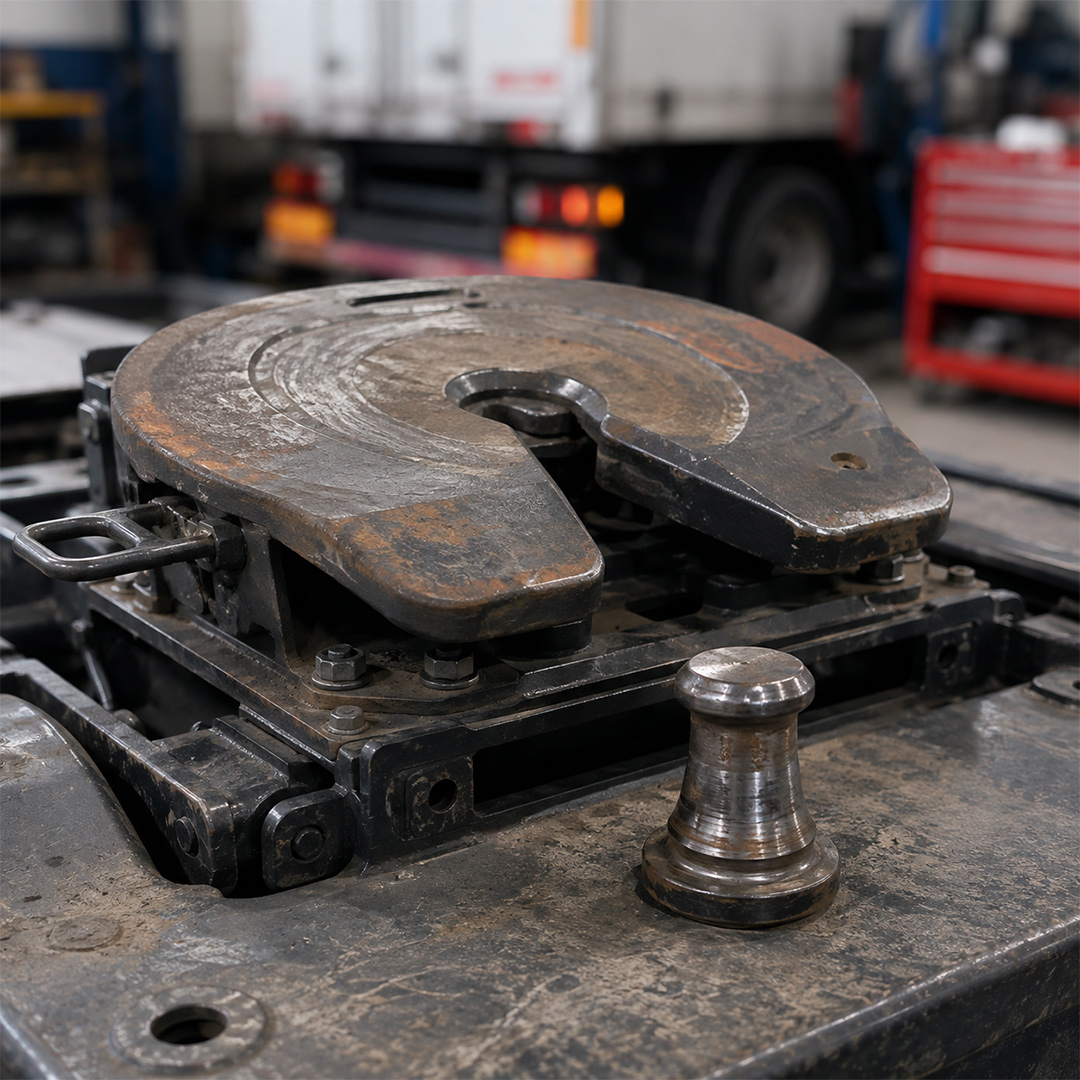
Why This Component Deserves Special Attention
The coupling and kingpin are among the parts in the entire vehicle that are subjected to the highest loads. They transmit enormous tensile, shear, and lateral forces —and they do so anew with every coupling operation, under friction. Wear is therefore inherent to the system and completely normal. It only becomes dangerous when it goes unnoticed. A worn-out lock or a worn kingpin leads to increasing play, which manifests itself as unpleasant jerking while driving—and, in extreme cases, can cause the trailer to detach.
That is why the wear measurement of the kingpin is also a standard inspection item during periodic inspections. We have described the details of how the §57a inspection is conducted in a separate article.
The two wear points: the latch and the pin
Wear occurs at two points that interact with each other:
- At the coupling lock: The locking hook and wear ring wear out over time. This causes the longitudinal play between the kingpin and the lock to increase. Many couplings can be adjusted here either continuously or in steps—only when the adjustment range is exhausted do the lock piece and wear ring need to be replaced.
- On the kingpin (drawbar pin): The contact surfaces on the pin itself wear out. If the pin falls below its minimum dimension, it must be replaced—a king pin is never repaired or welded.
Both parts must be considered together: A new kingpin in a worn-out lock is just as ineffective as a new lock on a worn pin.
Checking Properly: The Wear Gauge Matters
Reliable wear inspection isn’t done by feel, but with the manufacturer’s wear gauge. The big advantage: With such a gauge, both the coupling lock and the kingpin can be inspected while the coupling is disengaged and closed—usually with the same tool.
To put this into context, here’s a real-world example: In a brand-new coupling, a new kingpin results in very little operational clearance in the direction of travel—just a few tenths of a millimeter. Due to wear, this longitudinal play may increase up to a manufacturer-defined limit—after which it must be readjusted or the clutch replaced. The specific dimensions vary depending on the make and kingpin size (2 inches and 3 ½ inches are common), which is why the specifications and gauges provided by the respective manufacturer always apply here.
In addition to measuring with a gauge, every inspection also includes a visual inspection:
- Cracks and deformations on the coupling plate, lock, and kingpin—such findings require immediate action.
- Test the locking mechanism: The latch must close securely, and the locking lever must engage correctly. If anything sticks or catches, something inside is bent.
- Assess the vertical clearance of the locking tongue and assess the condition of the springs.
- Check the mounting plate, bolted connections, and welds for cracks and loose connections.
Modern couplings equipped with sensors provide additional support by electronically monitoring the lock status and pin position—but they do not replace mechanical inspection.
Lubricate—or deliberately not
Lubrication depends on the design, and this is where most mistakes are made:
- Traditional fifth-wheel hitches require grease on the fifth-wheel plate and the latch. Special lubrication grooves distribute it. Running dry accelerates wear significantly.
- Maintenance-free or “no-lube” couplings use plastic sliding surfaces and must not be greased on the plate. The rule here is: Grease mixed with road grime acts like sandpaper and does more harm than good.
The manufacturer’s documentation specifies which type is installed on your vehicle and which lubricant is intended, along with the required amount—if in doubt, it’s better to check once than to apply grease incorrectly.
When should you replace them?
A simple rule of thumb: Safety-critical parts should be replaced once they reach their wear limit—don’t keep driving “just a little bit longer.” Specifically, this means:
- Replace the wear ring and lock piece should be replaced when the adjustment range is exhausted.
- Kingpin Replace when the dimension falls below the minimum.
- In the event of cracks or deformation, , take the coupling out of service immediately and repair it.
Spare parts are easily accessible on most couplings and can be replaced relatively quickly—considering the cost of a failure, this is one of the most cost-effective safety investments there is.
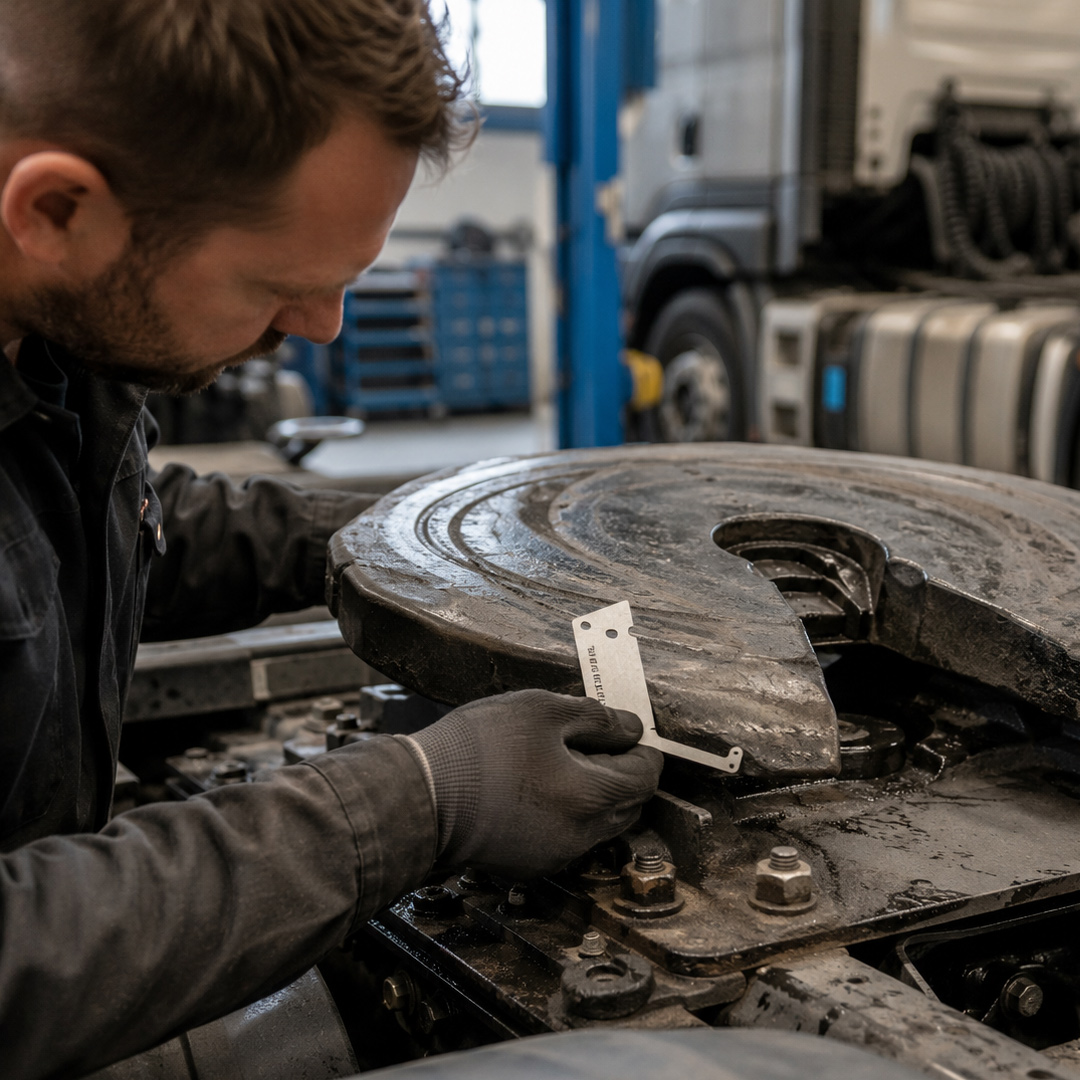
Wear Parts at FZB
As a full-range supplier with over 350,000 items, FZB carries wear kits, kingpins, and accessories for fifth-wheel couplings—compatible with all common makes and sizes. The best way to determine which part fits your coupling is to check directly through the FZB Webshop or contact your local FZB location. To place an accurate order, you’ll need the correct part number or model number—see “Find a Replacement Part by Part Number” to learn how to locate this information. To learn how wear inspection fits into vehicle maintenance in general, see “Maintaining a BPW Axle.”
Compatible parts: towing device, fifth-wheel coupling, and fifth-wheel kingpin.