
Brake Systems for Trucks and Commercial Vehicles
Brake System Design
The braking system of a heavy-duty commercial vehicle operates using compressed air and consists of four components: the compressed air supply system, which includes a compressor, air dryer, and air reservoirs; the control system, which includes brake valves, ABS, and EBS; the brake cylinders; and the wheel brakes on the axle, i.e., disc or drum brakes. In contrast, vans and light commercial vehicles typically use hydraulic brakes.
All components from a single source
On this page, you’ll find an overview of the system’s design, the appropriate spare part categories, and our guides on maintenance and inspection. As a full-range supplier with over 350,000 items, FZB carries parts for the entire braking system of trucks, trailers, and vans.
Compressed Air Supply: Where Brake Pressure Is Generated
The system begins with the compressor, which draws in and compresses air. A pressure regulator limits the system pressure, the air dryer removes moisture from the air, and a multi-circuit safety valve distributes the air to separate air reservoirs for the individual brake circuits. This separation ensures that a leak in one circuit does not disable the entire brake system.
The supply system is the part of the setup most vulnerable to moisture and cold. For information on what to do in winter, see the guide “Air Brake Systems in Winter.”
Matching Parts: Compressor/Compressor Parts · Air Dryer/Air Dryer Cartridge · Air Reservoir/Air Reservoir Accessories · Valves / Compressed Air System
Control and Regulation: How the Braking Command Is Transmitted
When the driver presses the pedal, the service brake valve controls the pressure to the axles. In modern vehicles, the EBS (Electronic Brake System) performs this task: The braking command is transmitted electrically, and the pressure for each axle is controlled electronically. ABS prevents the wheels from locking up, ASR prevents wheel spin when pulling away, and load-dependent brake force control adjusts the brake pressure according to the vehicle’s load. Additionally, the vehicle dynamics control system intervenes if the vehicle threatens to skid or roll over.
Compatible Parts: ABS / ASR / EBS · Brake Force Control/Limitation · Vehicle Stability Control
Brake Cylinder and Parking Brake
On each axle, brake cylinders convert air pressure into mechanical force. The axles equipped with parking brakes feature combination cylinders with an additional spring-loaded reservoir: A strong spring is kept taut by compressed air while the vehicle is in motion. When the air is released—whether during parking or due to a loss of pressure—the spring applies the brake. This ensures that the vehicle brakes in the event of a malfunction, rather than rolling uncontrollably.
Compatible parts: Brake cylinders/compressed air system · Brake/working cylinders · Parking brake
Wheel Brake: Disc or Drum
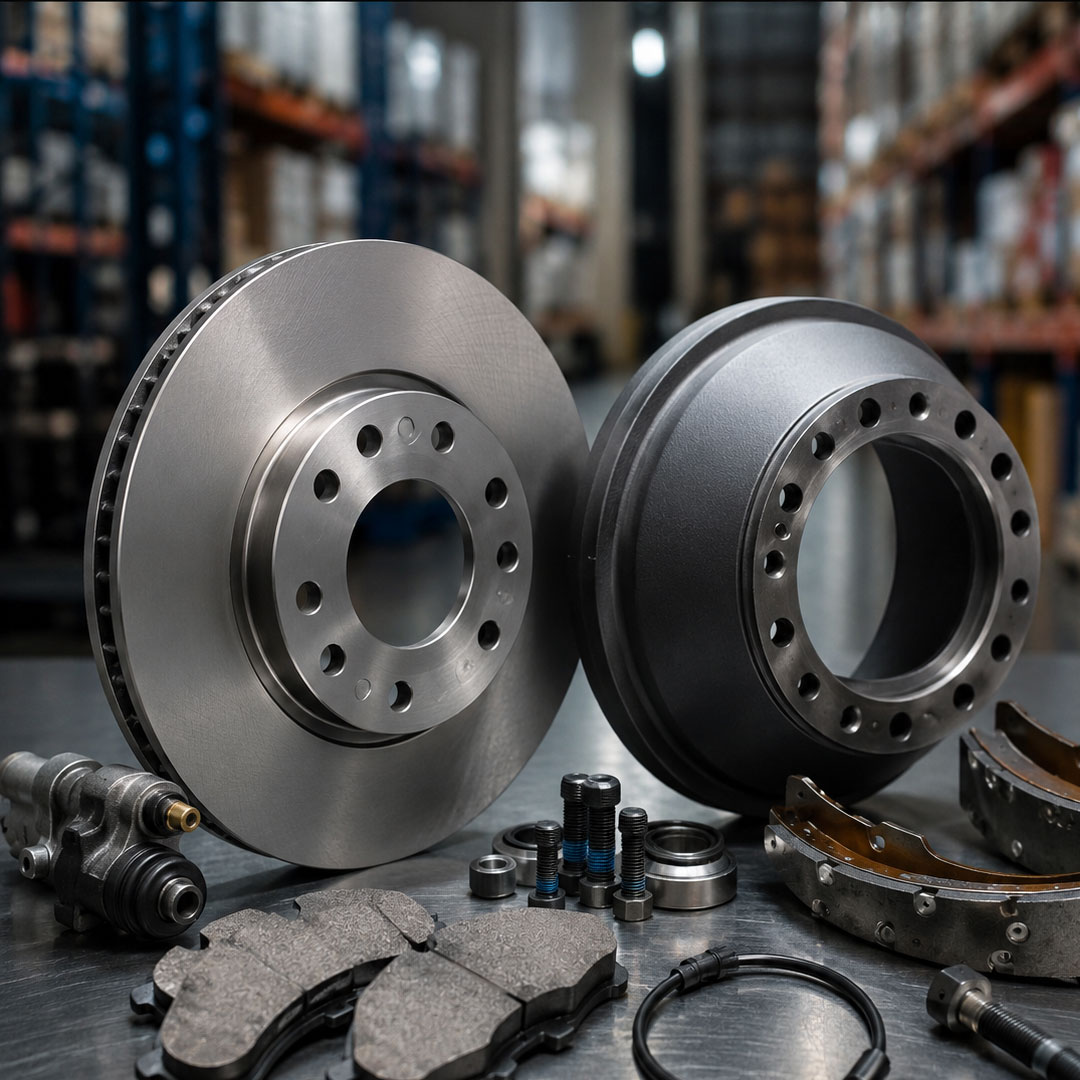
On the axle, braking force is converted into friction. Disc brakes are standard on modern axles and trailers, while the robust drum brake remains more common in agricultural and heavy-duty applications. Brake pads, discs, and drums are the system’s typical wear parts; a wear indicator signals when the pads are nearing the wear limit. The guide “Truck Brakes: Disc or Drum” explains how to recognize worn pads and when to replace them.
Matching Parts: Disc Brake · Drum Brake · Brake Caliper · Wear Indicator
Continuous brake: reduces the load on the service brake
On long downhill stretches, the friction brake would overheat. That’s why there’s the continuous-braking system, such as an engine brake or retarder. It operates without wear and maintains speed while keeping the discs and pads cool. In alpine terrain, it’s an essential safety feature.
Compatible parts: Continuous braking system
Connection to the trailer
The towing vehicle and trailer are connected by two air lines: the red supply line, which supplies the trailer with compressed air, and the yellow brake line, which transmits the brake signal. In addition, ABS and EBS trailers have an electrical connection. Leaky coupling heads and damaged lines are among the most common causes of air pressure loss in a trailer combination.
Compatible parts: Coupler head · Lines / Connectors · Brake hoses/lines
Hydraulic Brake Systems in Vans
Vans and light commercial vehicles typically use a hydraulic braking system similar to that of a passenger car: The master cylinder builds up pressure in the brake fluid, and the wheel cylinders or brake calipers apply that pressure to the wheels. The brake fluid is important here, as it absorbs water and must therefore be replaced regularly according to the manufacturer’s specifications.
Matching parts: Master cylinder/accessories · Wheel cylinder/accessories · Brake fluid reservoir/individual parts
Maintenance and Inspection
The braking system is one of the most critical inspection points during the §57a inspection: braking performance, the condition of the components, and the air tightness of the compressed air system are checked, and a braking defect can result in the loss of the inspection sticker. The §57a checklist for commercial vehicles shows you how to prepare.
Finding the Right Part
When it comes to safety-critical components, quality and a precise fit are essential. To determine whether an original part, an equivalent aftermarket part, or a replacement part is the best choice, see “Original vs. Aftermarket Parts.” “Find a Replacement Part by OE Number” explains how to find the right part using the OE or manufacturer number. You can find the entire product range in the FZB Webshop under “Brake System,” and receive personalized advice at your local FZB location.