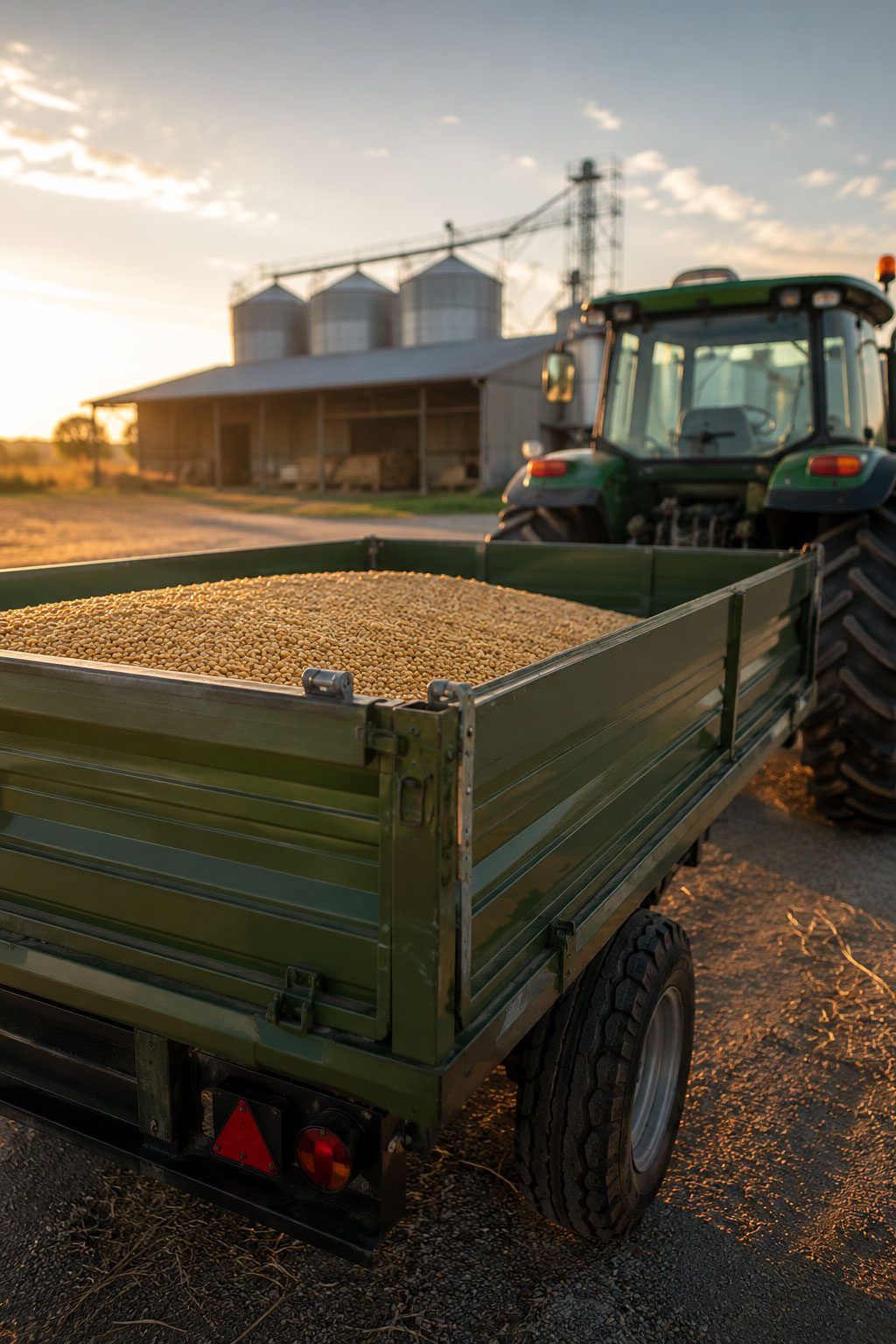
Pre-Operation Inspection of Trailers and Machinery
There’s no waiting room during harvest. When the weather window is open, every machine has to be running—a broken trailer doesn’t just hold itself up, but the entire chain from the field to the warehouse. The difference between a smooth season and a costly one is usually determined weeks in advance, in the shop. This checklist guides you through the key points that really matter before your first day on the job.
1. Brake system: the most important inspection point
Fully loaded trailers, steep dirt roads, tow vehicles pushed to their limits—the brakes bear the brunt of the harvest season.
- Check the compressed air system: Check the coupling heads, lines, and storage tanks for leaks. A gradual loss of pressure is rarely noticed during winter storage, but becomes apparent much more quickly on the road.
- Check the overrun brake: For trailers with a gross weight of up to 3,500 kg, an overrun brake is permitted—the transmission mechanism, linkage, and automatic reverse mechanism must be inspected and greased.
- Test the parking brake: It must securely hold the parked trailer in place—even on a slope and with the towing vehicle’s engine off.
- Inspect brake pads and drums: Worn pads cost more during harvest week than during a week at the repair shop. Our article “Replacing Truck Brake Pads” explains what to look for.
2. Axles, Wheel Bearings, and Tires
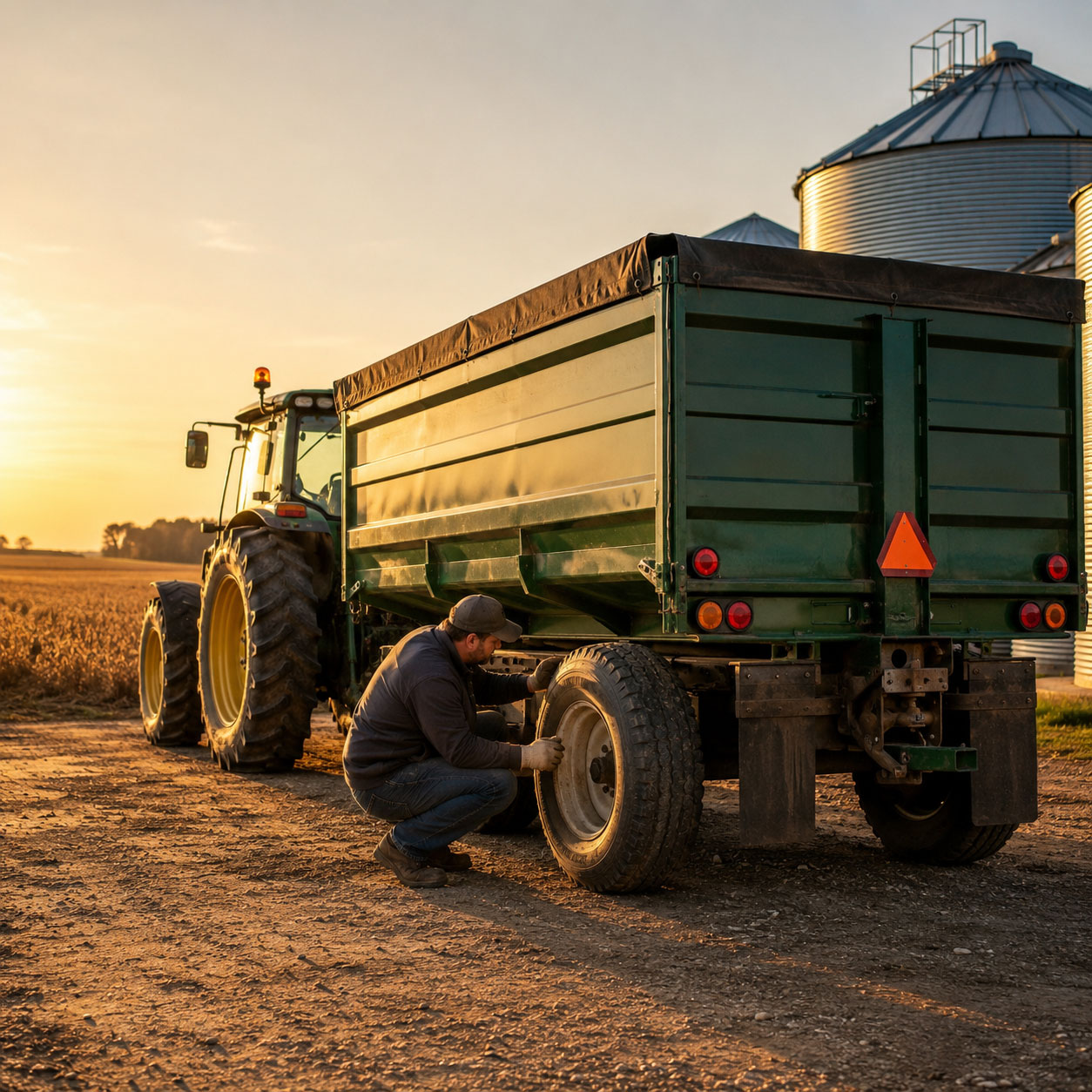
- Check for play in the wheel bearing: Jack up the wheel, wiggle it, and listen. If there is play or noise, check the bearings before the axle is damaged.
- Follow the lubrication schedule: Lubricate the axles and brake camshafts according to the manufacturer’s specifications. For more information on the technology behind this, see “BPW Chassis Systems Explained.”
- Tightening wheel nuts: After the first use and after every tire change, use a torque wrench—don’t rely on feel.
- Check tires: Tread depth, sidewall cracks, tire pressure. Tires must comply with the approval document in terms of type, size, speed rating, and load index.
3. Lighting and Markings
Harvesting trips rarely end while it’s still light out. Be sure to perform a thorough inspection, taking the towing vehicle into account:
- Taillights, brake lights, turn signals, and license plate lights
- Contour Lights: Trailers wider than 2,100 mm must be equipped with two clearance lights visible from the front and two from the rear—white at the front and red at the rear.
- Side marker lights: required for trailers longer than 6 m.
- Brake Lights on a Trailer: required if the towing vehicle’s brake lights are not visible to drivers behind due to the trailer’s size.
- Connectors and Wiring Harnesses: Corrosion in the contacts is the most common cause of malfunctions—clean the contacts and check the cables for signs of chafing.
For trailers not approved for road use, additional requirements apply, such as red reflectors (triangles pointing upward, no more than 90 cm above the ground) and the inscription “10 km” or “25 km” on the rear.
4. Inspection: Which trailer needs to get a “Pickerl”?
It’s worth taking a closer look here, because the rules depend on the speed limit:
- Exempt from periodic inspection are trailers that are not permitted to exceed 25 km/h, as well as tractors and motorized carts with a design speed of no more than 25 km/h, and self-propelled work machines or transport carts with a design speed of up to 30 km/h.
- Agricultural trailers with a speed of more than 25 but not more than 40 km/h: Inspection three years after initial registration, two years after the first inspection, and every two years thereafter.
- Agricultural trailers traveling at speeds over 40 km/h: three years after initial registration, two years after the first inspection, and annually thereafter (3/2/1).
Anyone who exceeds the legally mandated grace period is driving without a valid sticker—with corresponding consequences for both the driver and the vehicle owner. Therefore, be sure to schedule your appointment before the season starts, not in the middle of it.
Note: This article provides a general overview and is not a substitute for legal advice. The current version of the KFG and the information in your vehicle documents are authoritative.
5. Coupling, Assembly, and Load Securing
- Tow eye, coupling, and safety pin: Check for wear and play. Worn-out tow eyes are a common defect found during inspections.
- Note the tongue weight: It directly affects the towing vehicle’s steering ability.
- Sidewalls and Latches: Latches must close securely. Aluminum sidewall systems such as FZB Alu offer both weight savings and stability.
- Have securing equipment ready: Lashing straps, nets, and anti-slip mats are required on every trailer that leaves the farm premises. For specific legal requirements, see “Securing Cargo on Trucks.”
6. Hydraulics, Tipper, and PTO
- Check hydraulic hoses for porous areas and signs of chafing, and replace any leaky couplings.
- Lubricate the tilt cylinders and tilt joints; test the tipper lock.
- Check that the PTO guard is complete—a missing guard is a safety hazard, not just a cosmetic flaw.
7. Stock up on replacement parts—before the season starts
The most costly hours during harvest are those when a standard part is missing. Be sure to stock up on a small supply ahead of time: incandescent bulbs and LED lights, fuses, coupling heads and gaskets, tie-down straps, filters, and lubricants. Anything you can’t get on a Saturday night should have been ordered the Monday before.
A Quick Checklist to Print Out
- Brake system is leak-free, parking brake works, brake pads are in good condition
- Checked wheel bearings, lubricated axles, tightened wheel nuts to the specified torque
- Tires: Tread, Pressure, Sidewalls, Correct Size
- Complete lighting system, including contour and side marker lights
- Connections are clean; cables show no signs of wear
- Review date checked and, if necessary, scheduled
- Tow hitch, coupling, tongue load, and side panel latches inspected
- Hydraulics, tipper, and PTO guard inspected
- Cargo securing equipment on board and undamaged
- Wear and replacement parts in stock
FZB is with you all season long
Our decades of experience as a supplier of agricultural vehicle equipment are reflected in more than 350,000 products—ranging from BPW suspension systems to lighting and brake parts to load securing solutions. Five locations in Austria—Tribuswinkel, Kalsdorf, Kolsass, Linz, and Villach—ensure that the right replacement part reaches you quickly. Place your order in the FZB Webshop or contact your local FZB location. And if you’ve already set up your machinery properly this spring, all you need now is to put the finishing touches on it—as described in the “Spring on the Farm” guide.