
Winter Equipment Requirements for Trucks in Austria: What Takes Effect on November 1
There’s a lot of misinformation circulating about winter tires—and different rules apply to trucks than to passenger cars. Anyone who confuses the two risks a fine at the first inspection— and, in an emergency, far worse consequences. This article summarizes the Austrian regulations for commercial vehicles: deadlines, drive axles, tread depth, snow chains, and possible consequences.
Car or Truck? The Key Difference
For passenger cars and vehicles weighing up to 3.5 metric tons, a situational winter equipment requirement applies from November 1 through April 15: Winter tires are required only when winter road conditions actually prevail—that is, snow, slush, or ice.
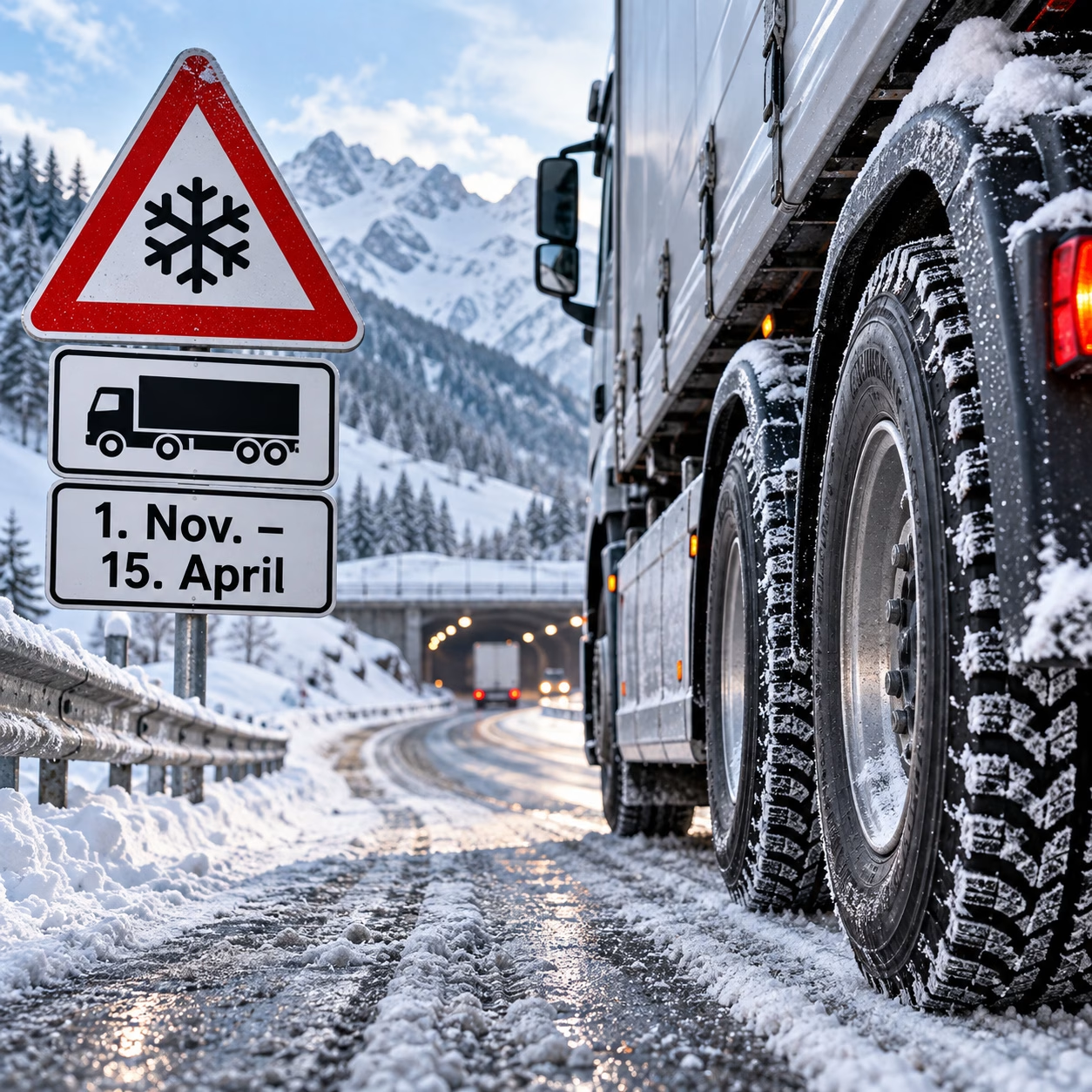
For trucks over 3.5 metric tons and buses, however, there is a strict winter tire requirement —based on specific dates and regardless of the weather. During this period, the vehicle must therefore be equipped with winter tires, regardless of whether there is snow on the ground or the sun is shining. This is precisely where the most common misconception arises: For heavy commercial vehicles, looking out the window is not the determining factor—the calendar is.
What specifically applies to trucks weighing more than 3.5 metric tons
- Period: November through April 15. For buses, the requirement to use winter tires ends on March 15—but the requirement to carry snow chains remains in effect until April 15.
- Drive axle: Winter tires must be mounted on at least the wheels of one drive axle. If the drive axle has dual tires, four winter tires must be mounted accordingly.
- Markings: A tire is considered a winter tire if it is marked with “M+S,” “M.S.,” or “M&S,” or if it bears the snowflake symbol. Alternatively, tires designated for “special” use (for alternating use on roads and off-road) are permitted; their tread depth must be at least 5 millimeters.
Tread depth: Stricter requirements apply to heavy-duty vehicles
One point that is often underestimated: Trucks weighing more than 3.5 metric tons must have a deeper minimum tread depth than passenger cars. The regulations require at least 5 millimeters for radial tires and 6 millimeters for bias-ply tires —compared to just 4 and 5 millimeters, respectively, for passenger cars.
In practice, this means that if you start out on November 1 with exactly the minimum tread depth and drive a lot, you’ll fall below that threshold by the middle of the season. It therefore makes sense to set an internal limit above the legal minimum and to perform a documented tire check before winter —recording the tread depth, age, condition, and axle position before the tires are remounted.
Snow Chains: Carrying Them Is Mandatory
In addition to winter tires, trucks weighing more than 3.5 metric tons and buses (classes N2, N3, M2, M3) are required to carry snow chains: From November 1 through April 15, suitable snow chains for at least two drive wheels must be on board. This applies even if the drive axle has dual tires.
When using snow chains, one rule is crucial: Snow chains may only be installed if the road surface is completely or nearly completely covered with snow or ice —otherwise, they will damage the road. And here’s a common misconception: Summer tires plus snow chains do not exempt you from the requirement to use winter tires. If there is slush, the winter tire requirement applies, but chains cannot be used at all because there is no solid snow cover—you would get stuck. Furthermore, you should not drive faster than about 50 km/h with chains on.
Consequences of Violations
Anyone driving without the required winter equipment during the designated period risks a fine if stopped for a traffic check—starting at around 60 euros for minor violations. It becomes significantly more expensive if other road users are endangered as a result: In such cases, the penalties under the Motor Vehicle Act (§ 134 KFG) can reach up to 10,000 euros. In addition, failure to have the required equipment can lead to insurance-related consequences following an accident. For fleets in particular, proper documentation is therefore not just paperwork, but a safeguard.
Get Ready in Time — with FZB
Winter tires, snow chains, replacement parts, and everything else you need for the cold season are at the heart of the FZB product lineup. As a full-range supplier with over 350,000 items and five locations in Austria—Tribuswinkel, Kalsdorf, Kolsass, Linz, and Villach—we make sure you’re equipped in time. Place your order in the FZB web shop or contact your local FZB location. Since winter equipment is also a checkpoint during the §57a inspection, it’s worth planning both together—just like the seasonal trailer and machinery check.
Compatible parts: snow chains, wheels.