Retrofitting LED Lighting for Trailers: Regulations & Benefits
LED lights are brighter, last longer, and use less electricity. No wonder so many operators want to retrofit their trailers. The catch: Not every LED light can simply be installed. If you take the wrong approach here, you risk a failure during the §57a inspection. This article explains the legal requirements and why the retrofit is still worth it.
The most important rule: the entire light assembly counts
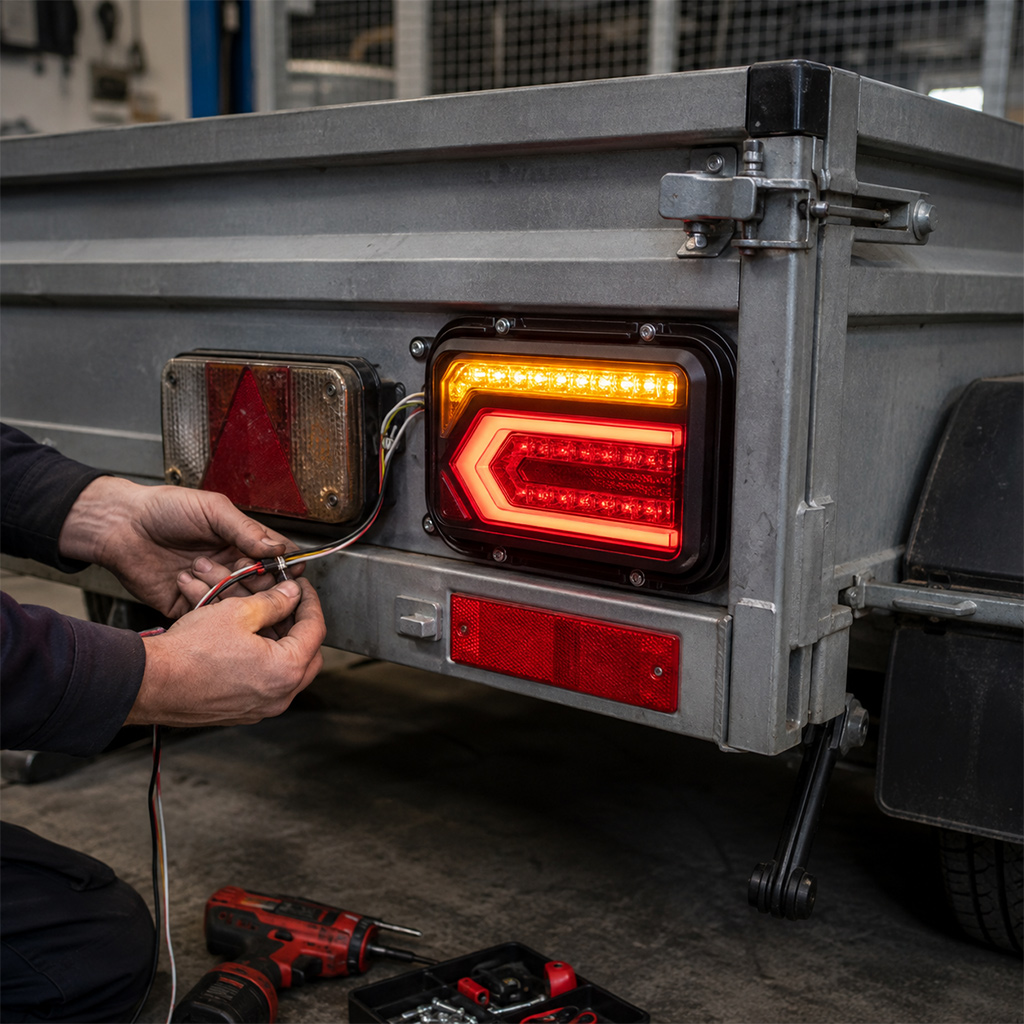
In Austria, vehicle lighting must have a type approval (known as “E-certification”). Only lights that have the appropriate approval may be installed. The key point here is that approval is granted for the entire lighting unit —that is, for the combination of the light source, reflector, and lens.
This leads to the following rule of thumb for retrofitting:
- It ispermitted to replace the entire light with an LED light that bears a valid certification mark. Tail lights, turn signals, brake lights, clearance lights, and license plate lights for trailers are available as ready-made, certified LED units.
- As a general rule, it isnot permitted to simply replace the light source in a socket designed for incandescent bulbs with an LED “bulb” or “cartridge.” The reflector and lens are designed to work with the incandescent bulb —the LED would emit light differently and could blind other road users.
For a typical trailer, this means: Replace the old light with a compatible, certified complete LED light—and you’ll be on the safe side.
How can I tell if an LED light is approved?
The proof is on the light itself: the E-mark —an “E” (or “e”) inside a circle or rectangle, followed by a country code and the approval number. In addition, there is a reference to the relevant ECE regulation that defines the type of light (such as for turn signals, tail lights, brake lights, or license plate lights).
What to Look for When Buying:
- Valid E-mark for the specific lighting function.
- Correct voltage: Trailers in the commercial vehicle sector often operate at 24 V, while passenger car trailers operate at 12 V. Some LED lights are designed for both (12–24 V)—check if in doubt.
- Proper function and mounting position: The regulations regarding mounting height and location apply to LEDs just as they do to incandescent bulbs.
A note on so-called retrofit LED bulbs, which simply replace incandescent bulbs: Their approval in Austria is a special case; it applies only to certain, explicitly approved applications and, in some cases, requires you to carry a certificate. For trailer lighting, using a tested complete light assembly is clearly the cleaner solution.
Don’t Forget the Attachment Requirements
The retrofit does not change the mounting requirements. Depending on the trailer’s size, additional lights are required—such as clearance lights for trailers wider than 2,100 mm and side marker lights for trailers longer than 6 m. If you’re retrofitting anyway, it’s best to bring the lighting system fully up to code right away—this will save you from any disputes later during the §57a inspection.
The Stumbling Block in Practice: The Lamp Failure Check
A technical detail that regularly causes headaches in the shop: Many towing vehicles monitor trailer lighting via a lamp failure check. Because LED lights consume significantly less power than incandescent bulbs, the control unit sometimes interprets this as a “defective lamp”—even though everything is working properly.
Two solutions have proven effective:
- Use electronics-compatible LED lights that are designed for the towing vehicle’s failure monitoring system.
- Where necessary, install appropriate resistors or control modules that simulate the power consumption required for the check.
This must be taken into account from the very beginning when planning the retrofit—otherwise, everything will light up, but the dashboard will complain.
Why the retrofit is worth it
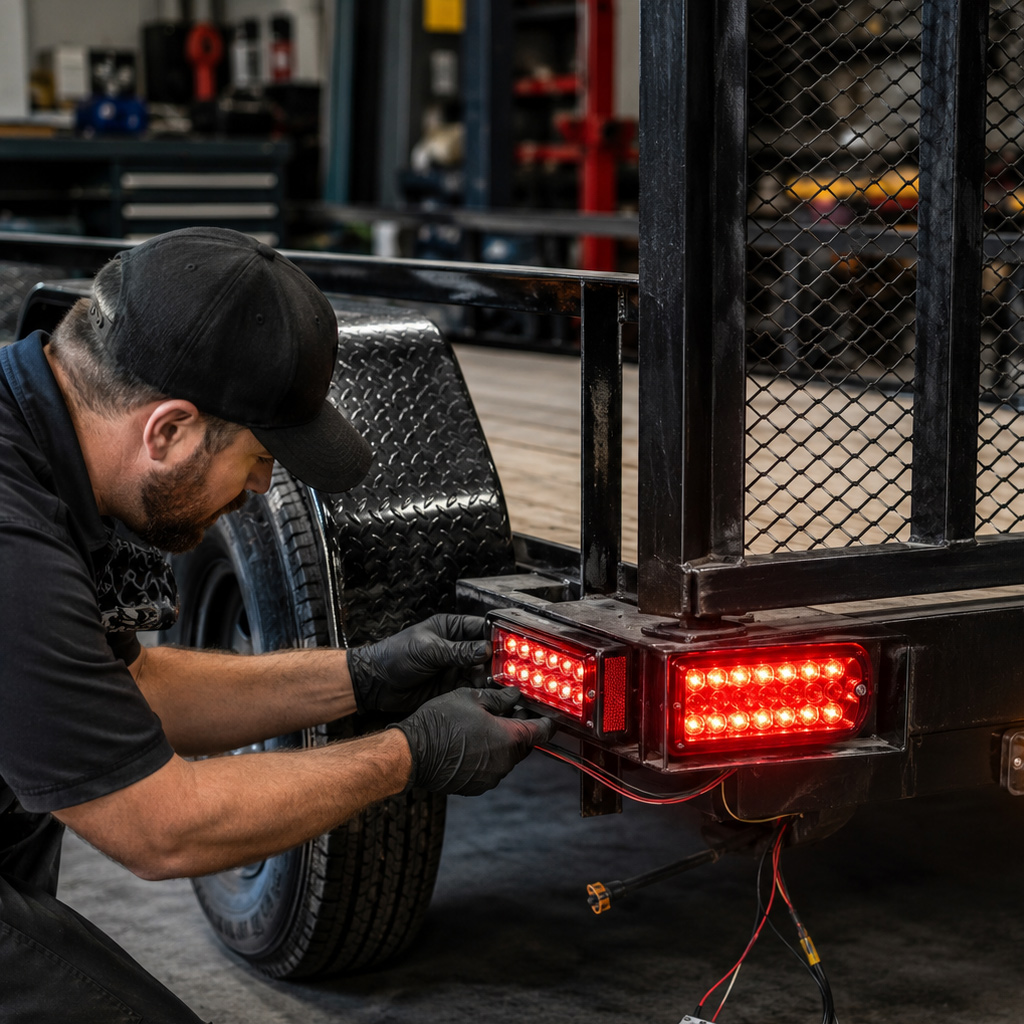
If the registration is in order, the benefits clearly outweigh the drawbacks:
- Lifespan: LED lights last many times longer than incandescent bulbs—fewer failures, fewer replacements, and less downtime.
- Vibration resistance: No filament that can break. A real advantage, especially in agricultural and construction site applications with constant vibration.
- Faster response: Brake lights and turn signals illuminate with virtually no delay—allowing following traffic to react sooner. A direct safety benefit.
- Lower power consumption: reduces the load on the wiring harness and vehicle electrical system, especially on long trailers with many lights.
- Fewer complaints: Properly functioning, long-lasting lighting is one of the most common sticking points during inspections and for vehicle inspection stickers—reliability pays off immediately here.
Over the years, this more durable, low-maintenance lighting is the more cost-effective solution for most businesses.
Finding the Right Light
As a full-range supplier with over 350,000 items, FZB carries certified LED lights, wiring harnesses, connectors, and control modules for trailers. The quickest way to determine which light is right for your trailer configuration, voltage, and mounting situation is to check the FZB online store or contact your local FZB location. To order the exact replacement light, you’ll need the correct part number—see “Find a Replacement Part by Part Number” to learn how to locate it.
Related parts: Lighting, electrical kits, and trailer hitches.